
Luca Tabone
How to build your own AI property manager: what it really takes, what it really costs
The honest, end-to-end build of an AI property manager, with the details a demo never shows.
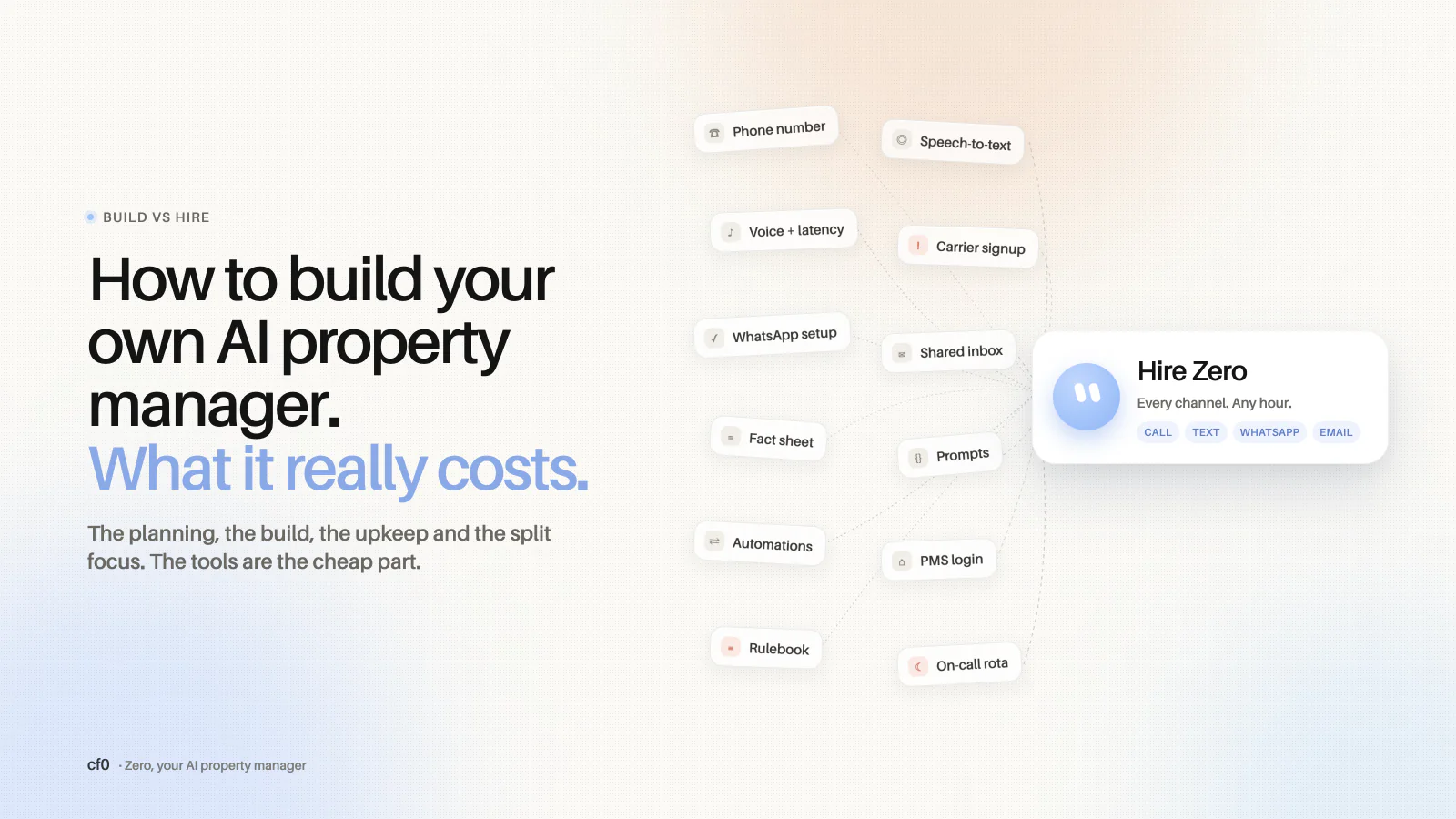
My name is Luca, and I am building Zero at cf0.
This is what we do: we turn the software you already use into an employee that works day and night:
Your PMS → your units, tenants and owners → Zero's own number and inbox → every call, text, WhatsApp and email answered → showings booked, work orders opened, rent reminders sent → logged back in your PMS
The goal: connect your PMS in seconds. Then every lead, tenant and owner gets an answer, and the work gets done, at any hour.
This is a step-by-step playbook for property managers, leasing teams and short-term rental operators who still run their firm with people only. We build and run an AI property manager every day, and we update it constantly. So this is the honest, end-to-end build, with the details a demo never shows. Read it to the end: the last section can save you months.
(No time to read? Call Zero on +1 650 536 0840. You will talk to the employee in this article.)
Intro: the operator's trap
You run a good firm. Your team knows every unit, every owner and most tenants by name. During office hours, it works.
Then the office closes at 6, and the messages keep coming. At 9pm a tenant writes that the heat stopped. At 11pm a renter asks about a two-bedroom. On Saturday an owner asks why the rent is late. In a human-only firm, the answer comes from your own cell phone, the on-call phone, or nobody.
You may say: "We have an on-call phone. We are fine." It covers a burst pipe. It does not answer the 11pm lead, book the showing or tell the owner about the rent. Those wait for 9am.
So you price out the fixes. To staff every hour, you need 4.2 people, about $294,000 a year. An answering service is cheaper, but it only takes messages.
So you land on the option that looks cheap: build your own AI. Many of you look at ChatGPT and think: "We can build this ourselves." The reasons are good. You know your properties better than any vendor. You control your data and your tone. A ChatGPT or Claude plan costs less than a team lunch. Add a few prompts, a phone number and a link to your PMS. How hard can it be?
Here is the honest answer. You can build it, and the first demo will impress you. But an AI property manager is nine projects in one, and each can quietly break the others. Most firms find this out after the demo, while one of their best people spends their evenings on it.
Part 1: the math nobody shows you
Before you build anything, look at your week. This chain is the whole problem:
168 hours in a week → 45 hours with someone at the desk → 123 hours with nobody → leads that wait until morning → units that sit empty
Where each number comes from:
- 168 → 45. An office open 9 to 6 on weekdays covers 45 hours. That is about 27% of the week.
- 45 → 123. The other 123 hours are evenings, nights and weekends. For about 73% of the week, nobody answers.
- The weekend gap. Your office closes at 6pm on Friday and opens at 9am on Monday. That is 63 hours. A renter who writes on Friday evening waits almost three days.
- Slow replies lose leads. In 2011, Harvard Business Review published a study of 2,241 US companies. Firms that tried to reach a lead within an hour were nearly 7 times as likely to qualify it. That is against firms that tried an hour later. Against firms that waited 24 hours or more, they were more than 60 times as likely. Your Friday evening lead is in that last group.
- Lost leads mean empty units. Take an illustrative rent of $2,000 a month. Each week that unit sits empty, you do not collect about $461. One extra empty week on 10 units is about $4,610.
Now the limit that applies during office hours too: one person answers one call at a time. When your leasing agent is at a showing, the office phone rings. When they are on a call, the WhatsApp waits.
And the hours do not go to the big problems. They go to the hand-offs. Look at two normal requests.
One leak under a kitchen sink:
- The tenant calls. Someone asks the right questions. Is water still running? Where? Since when? Can they turn off the valve?
- Someone decides: emergency tonight, or a plumber tomorrow?
- Someone finds a plumber who is free, and checks the owner's approval limit for repairs.
- Someone agrees a time with the tenant and arranges access for the plumber.
- Someone chases the plumber for photos, the invoice and a "done".
- Someone tells the owner what happened and what it cost.
One lead from Zillow:
- The inquiry arrives by email, often with only a name and "Is this still available?"
- Someone replies, then asks about move-in date, pets, parking and budget.
- Someone offers showing times that do not clash with the rest of the team's showings.
- Someone confirms, sends a reminder, and follows up after the showing or the no-show.
- Someone sends the application link and answers the questions it raises.
None of these steps is hard. But each request is five or six steps, across two or three people, on three or four channels. Multiply that by every unit you manage, every week. That is where your team's week goes.
Expert note before we build: the biggest lever in all of this is the first reply. How fast does it go out, and are its facts right? Every build step below serves one of the two.
Part 2: step by step, what you actually have to build
Step 1: the rulebook (40 to 50 situations, before you write a prompt)
Before your agent answers anyone, someone must decide what it may say and do. Write it all down and you get 40 or 50 situations. Each one has its own rules and exceptions:
- What does it do alone, and what must it never do?
- Who does it wake at 2am for a gas smell? What can wait until morning?
- How does it hold a showing slot that your leasing agent did not already give away?
- What does it tell an owner who asks why the rent is late?
- When does it hand a conversation to a person? How does that person see the history?
In a software company, this document is a spec, and writing specs is a full-time job. In a property firm, it goes to the person who suggested the project.
Step 2: the phone line (a number, two speech models and a voice)
Voice is the hardest channel. You need a phone number from a carrier, connected to your agent. You need speech-to-text to hear the caller and text-to-speech to answer. The AI model sits between them.
Then come the details that decide if callers trust it:
- Pauses. Callers stop in the middle of a unit number or an email address. If the agent replies at the first pause, it cuts them off. If it waits too long, every reply feels slow. One setting moved our own reply time from 2.2 seconds to about 1 second.
- Interruptions. Callers talk over the agent. It must stop at once and listen.
- Models that think out loud. Some AI models write out their reasoning. On a call, the voice can read that reasoning to the caller.
- Real phone lines. Weak cell signal, traffic noise and accents all change what speech-to-text hears.
- Emergencies. For a gas smell or a flood, the agent must transfer the call to your on-call person, with the details.
Step 3: texts, WhatsApp and email (three setups, three sets of rules)
Each channel is its own vendor, its own setup and its own bill. It also fails in its own way:
- Texts. In the US, business texting needs carrier registration, called 10DLC. You register your brand, then a campaign that describes your messages. Approval can take days or weeks.
- WhatsApp. You need a verified Meta business account. After a tenant writes, you have 24 hours to reply freely. Outside that window, any message you start must use a template that Meta approved first. So a rent reminder to a tenant who last wrote in March needs a template.
- Voice notes and photos. On WhatsApp, tenants send a voice note and a photo of the leak. Your agent must transcribe the note and look at the photo, or it misses the request.
- Email. Your agent needs its own address, with SPF, DKIM and DMARC records, so its replies do not land in spam. It must also ignore its own messages and out-of-office replies. If not, two automatic systems email each other all night.
- Style per channel. An agent that sounds natural on a call can paste stage directions like "[laughs]" into a text. You must stop that on every written channel.
Step 4: one history per person and unit (the part demos skip)
A tenant calls on Monday, sends a photo on Tuesday and emails on Wednesday. Your agent must know it is the same person, the same unit and the same leak.
Then real life gets messier. A tenant texts from a new number. A partner calls about the same apartment. An owner forwards a tenant's email. The agent must match each one to the right person and unit. If it gets this wrong, it answers with the wrong facts, or shares one tenant's details with another.
Step 5: getting inside your PMS (read and write access, unit by unit)
This step makes the agent useful. Without it, you have a receptionist with good grammar, and your team still does every job.
Your agent must read from your PMS. It must see which units are vacant, who lives where and what the ledger says. It must also write back: open a work order, log a note, record a showing.
That is harder than it sounds:
- Some PMS tools give API access only to approved partners. Others have no public API. Then the only way in is a script that logs in like a person, and it breaks when a screen changes.
- APIs return data one page at a time. If your code reads only the first page, your agent cannot see half your units. And it does not know what it is missing.
- Tenants do not use unit IDs. They say "the apartment over the laundry room". Your agent must map those words to the right unit.
- When the PMS is slow or down, your agent must stop safely and alert a person. It must not guess.
Step 6: keeping the facts current (every unit, every day)
An agent is only as good as its facts. Rents change. Units get leased. Pet rules, parking, deposits and showing hours change. Your Zillow listing and your PMS record start to disagree.
If nobody keeps them in sync, your agent confidently offers a two-bedroom that someone leased on Tuesday. Someone must own this every day. If not, the speed you gained becomes a fast way to give wrong answers.
Step 7: testing (before every change)
A demo works on the questions you thought of. Tenants ask the ones you did not.
So you keep a set of test conversations. The angry tenant. The lockout at midnight. The owner who wants a number now. The lead who asks three questions in one message. The tenant who tells the agent to ignore its rules. You run all of them again after every change, because a fix in one place can break another.
Step 8: the daily upkeep (about a third of one manager's week)
You do not install an AI agent once. It is more like a product, and you are its only customer. Budget a third of one manager's week for it, because things change under it all the time:
- The AI model gets an update, and the answers change.
- The model provider changes how a setting works. For us, a setting that worked for weeks suddenly made our agent fail in the middle of conversations.
- The automation platform changes, and one step stops without a warning.
- A carrier or Meta changes a rule, and messages stop arriving.
So someone reads last night's conversations every morning. Someone takes the call when it breaks on a Saturday. We update Zero constantly for exactly these reasons.
When the person who built your version leaves, nobody else knows how it works.
Step 9: your team's focus (never on an invoice)
The person who can build this is usually one of your best operators. Each hour on prompts and integrations is an hour away from owners, tenants and new business. Your best ops person becomes a part-time software engineer. A property firm with a software side project usually does both jobs a little worse.
You did not build your own property management software. You did not write your own accounting software. You could, in theory. You did not, because software is not your business.
Part 3: the real price tag
Add it all up. Here is the yearly cost of building it yourself:
- AI tools and an automation platform: about $50 to $100 a month, so about $600 to $1,200 a year
- Phone numbers, voice minutes, 10DLC registration and WhatsApp setup: extra
- The rulebook and the test conversations: one senior person's time up front, then more for every change
- Upkeep: a third of one property manager's week, about $23,000 a year (at the $69,990 US median wage, Bureau of Labor Statistics, May 2025)
- Total: about $24,000 a year, before the setup work and the Saturday it breaks
- Result: an agent that one person in your firm understands
And that is the lean path. The alternatives:
- Answering service: Ruby charges $720 a month for 200 minutes, about 100 calls, or roughly three a day. Smith.ai starts at $300 a month for 30 calls, then $11.50 per call. They take messages. The work still waits for morning.
- Staff every hour: 4.2 people, about $294,000 a year before benefits. In the UK, at the £25,464 Glassdoor average for a lettings negotiator, it is about £107,000.
- Stay as you are: 123 hours a week with nobody answering. Each empty week on a $2,000 unit costs about $461 (illustrative).
So your real options as a human-only firm: pay for people at every hour, pay a service to take messages, or give a homemade agent $24,000 a year and one of your best people. Or keep losing the leads that write after 6pm.
That is the trap. An AI property manager looks like a prompt and a phone number. In fact it is nine projects, and each one can quietly undo the others. If you tried and stopped, you did nothing wrong. You tried to build a software product as a side project.
If you have an engineer on staff and enjoy this work, build it. If not, you want the result, not a new department.
Part 4: how to answer every lead and tenant, day and night, for $0 to start
Now the same result, without any of the above.
Zero is an AI employee, not software. You hire it like a team member, and it gets its own phone number and email. It connects to your PMS in seconds. That is the setup.
Once connected, Zero:
- Reads your PMS and learns your units, tenants and owners
- Answers every call, text, WhatsApp and email, at any hour
- Qualifies leads and books showings
- Opens work orders and alerts your on-call technician
- Sends late-rent reminders and owner statements
- Logs everything back in your PMS, in one thread per unit
Here is how it works. These are real conversations with Zero. First, 8am: the manager checks in after a busy night.
And here is the late-night call from that briefing. The front door wouldn't lock:
No rulebook from a blank page, no phone line to tune, no 10DLC forms, no WhatsApp templates, no PMS scripts, no 7am transcripts and no 4.2 night hires. We run the hard parts, and we update Zero constantly so you do not have to.
What changes when Zero joins your team:
- 98% of leads answered
- 9x faster lead response
- 380% higher lead-to-lease conversion
- 45% less time vacant
- 15% of your team's week back
You run the properties. Zero answers the messages.
Up to 150 units, Zero costs $1,500 a month. That is $10 a unit at 150 units. Above 150 units, we agree on a price with you on a call. And you can test it for free: your first two weeks are on us.
The DIY path: about $24,000 a year, nine projects and one of your best people. The Zero path: your PMS, a few seconds, and $1,500 a month after two free weeks.
Hear it for yourself
Call Zero on +1 650 536 0840. It answers at any hour. It explains what it can do for your firm and can book a call with me. Outside the US? Go to cf0.ai and click "Talk to Zero".
To see Zero work on your own properties, book 30 minutes with me: cal.com/luca-tabone/discovery-call(opens in a new tab)
Already built your own? Keep it. Run Zero next to it for two free weeks. Then decide which one you want to maintain.
Luca
First published on LinkedIn(opens in a new tab).